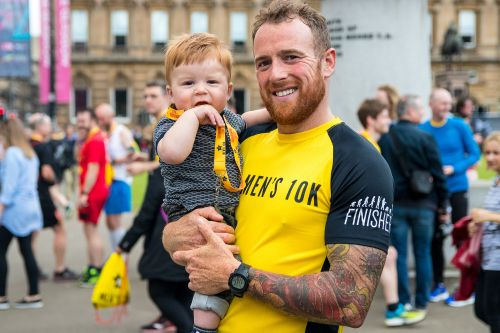
The Men’s 10K Edinburgh takes runners from the historic Lawnmarket through some of the capital’s most recognisable streets before a grandstand finish at Scottish Gas Murrayfield Stadium.
It looks like a compact city race. Operationally, it involves protected historic streets, public parks, major junctions, city-centre transport and a point-to-point baggage operation—all within a short period.
Designing a Route Through a Living City
The route passes the Scottish National Gallery, Princes Street Gardens, the Scottish Parliament, Holyrood Park and the Grassmarket before heading to Murrayfield.
Every location brings different constraints. The Royal Mile has narrow pavements and heavy visitor numbers. Parks contain public paths and sensitive surfaces. Central junctions affect buses and local access.
Course planners examine where runners will spread out, where spectators are likely to congregate and where emergency vehicles can gain access.
The 10K distance also means the event moves quickly. Roads cannot be closed and reopened as one block; the operation progresses across Edinburgh in sections.
Starting on the Lawnmarket
A historic street does not come with permanent start pens, baggage zones or timing systems. These must be installed temporarily and removed without damaging the setting.
The start team positions barriers, toilets, signage and information points before participants arrive. Pens are designed around predicted finishing times to reduce congestion after the gun.
Baggage trucks need accessible loading positions. Every bag must leave for Murrayfield before road closures make movement more difficult.
Staff also manage late numbers, participant questions and nervous first-time runners. When the final pen departs, they begin dismantling the start while the race continues elsewhere.
Volunteers Across the Capital
Course marshals stand at turns, crossings and spectator hotspots. Their task is part direction, part observation and part communication.
They need to know the route precisely. A confident gesture at the right moment prevents hesitation, while a marshal at a pedestrian crossing protects both runners and the public.
Volunteers report hazards and medical incidents to race control. They may also deal with residents seeking access or visitors unaware that a race is taking place.
At Murrayfield, another group receives finishers, distributes medals and directs runners towards baggage and reunion areas.
Medical Preparation for a Fast Race
A 10K can attract a wide range of participants, from competitive runners operating near their limit to people attempting their first organised event.
The medical plan accounts for that diversity. Resources are placed along the course and at the finish, with access routes identified in advance.
Holyrood Park, the Old Town and the approach to Murrayfield each present different response considerations. Exact location reporting is essential.
The finish team watches for participants who appear unsteady, confused or distressed. Even after a relatively short race, sudden stopping can expose underlying problems or cause runners to become dizzy.
Race Control and the Moving Field
Race control tracks the leaders, main field and final participants. These positions determine when staff should prepare, when roads can reopen and where medical teams need to remain alert.
Information arrives by radio from sector managers and marshals. If a barrier moves or a pedestrian enters the course, race control decides what response is needed.
The team coordinates with traffic management, police, medical providers and stadium operations. It also monitors whether the timetable remains on schedule.
Because the Women’s 10K follows later on the same event day, decisions must account for the next race as well as the one currently underway.
The Murrayfield Finish
A stadium finish creates a powerful participant experience, but it requires controlled access and careful runner flow.
The route into Murrayfield must remain clear. Timing mats, backup systems and finish cameras are tested before the leaders arrive.
Runners need space to slow down after crossing. Volunteers then guide them through medal, hydration and baggage areas.
Spectators must be separated from finishers until they reach the reunion zone. This protects the timing operation and prevents the narrow exit from becoming blocked.
Baggage transported from the Lawnmarket is arranged by number, allowing runners to retrieve belongings without searching through hundreds of bags.
Road Closures and Public Transport
Central Edinburgh cannot stop functioning entirely for a 10K. Closures are therefore timed and zoned, protecting the field while limiting disruption.
Transport operators plan diversions around the Royal Mile, Holyrood, Grassmarket and the route towards Murrayfield. Drivers and passengers need advance notice.
Event-day traffic staff monitor barriers and access points. Roads reopen only when the final participant and sweep operation have passed and equipment is removed.
The tram system is particularly important for moving supporters between the centre and Murrayfield. Organisers must consider the volume of people arriving at platforms after the start and leaving after the finish.
Supporting the Volunteers
Volunteer welfare is an operational responsibility. Marshals may stand for hours in cold or wet conditions, so they need clear arrival instructions, suitable equipment and access to refreshments.
Briefings explain not only the volunteer’s role but what lies outside it. Volunteers should report medical problems rather than attempt treatment beyond their training.
Supervisors check positions, provide replacements where possible and ensure no marshal is forgotten when the course closes.
Recognition after the event matters. Volunteers are essential to the race’s friendly atmosphere and safe delivery.
Resetting for the Women’s 10K
The Men’s 10K does not end the event day. Teams must prepare for the Women’s race using much of the same infrastructure.
Start pens are checked, supplies replenished and any moved barriers corrected. Medical and volunteer teams review incidents from the first race.
Timing systems must be ready for a new field, and baggage operations reset. Murrayfield finish stocks are counted so medals and refreshments remain sufficient.
This turnaround is one of the day’s most demanding periods because the public may perceive it as a quiet gap while teams are working at speed.
Learning After the Event
Once both races finish, infrastructure is removed and the city returned to normal.
Managers collect reports about start flow, crossings, medical incidents and stadium movement. Timing data and participant enquiries are checked.
A debrief identifies changes for the following year. Even a successful event generates lessons.
Behind the Men’s 10K Edinburgh is a team working across historic streets, public spaces and a national stadium. Their achievement is not only staging a race, but making a complex city operation feel straightforward to the runner.