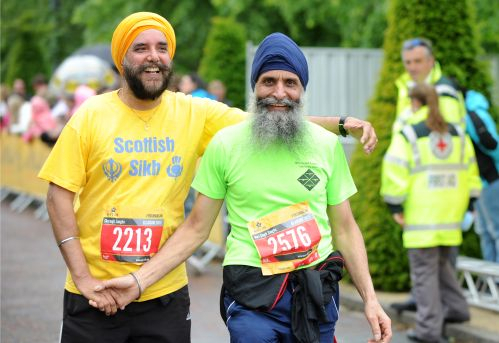
The Men’s 10K Glasgow begins beside the Riverside Museum, follows the River Clyde past some of the city’s most recognisable modern landmarks, crosses into the city centre and finishes in Glasgow Green.
For runners, the event is a fast-moving tour of Glasgow. They experience the anticipation of the start, encouragement through the central streets and the relief of crossing the finish line. Behind that public-facing experience is a point-to-point operation involving bridge crossings, busy roads, transport restrictions, baggage vehicles, medical teams and hundreds of pieces of temporary infrastructure.
The race itself lasts only part of a morning. Delivering it successfully requires months of preparation and a team whose work begins long before the first participant arrives.
Creating a Course Along the Clyde
The course uses riverside roads, bridge approaches, pedestrianised streets and parkland. Each surface and location introduces a different operational consideration.
Course teams inspect every turn, gradient and potential conflict point. They consider where runners will remain tightly packed, where the field is likely to spread and where spectators may gather in large numbers.
The early section passes landmarks such as the Glasgow Science Centre, SEC Armadillo, SEC Centre and OVO Hydro. These areas attract visitors even without a running event, so the route must account for normal pedestrian and venue activity.
The Clyde Arc and George V Bridge create memorable race moments, but bridges can also become operational pinch points. Barriers and marshals are required to separate runners from public movement and prevent anyone entering a restricted section.
Buchanan Street and George Square bring the race into the commercial heart of Glasgow. Glasgow Green then needs enough capacity for the finish, medical facilities, baggage collection and waiting spectators.
A route that appears simple on a map is therefore divided into operational sectors, each with its own staffing, signage and emergency-access plan.
Building the Riverside Museum Start
The Riverside Museum area must become a functioning start village before runners arrive.
Start pens, toilets, baggage vehicles, information points, barriers and timing systems are installed according to a detailed plan. Vehicle access for deliveries is carefully controlled, particularly once road restrictions begin.
Timing technicians lay and test the starting mats. The system must register every participant accurately, including runners crossing in later waves.
Volunteers report early for briefings and receive their positions. Some direct participants towards baggage trucks, while others answer questions about start pens, toilets or replacement event numbers.
Normal museum parking and drop-off facilities may be unavailable. Alternative travel and drop-off arrangements therefore form an important part of the arrival plan.
Staff monitor the flow of people coming from Partick station, event buses and designated pedestrian routes. If queues begin to build, the information is reported so adjustments can be made.
As the start approaches, runners move into pens based on predicted finishing times. Releasing the field in a controlled sequence reduces congestion during the opening kilometres.
Once the final runner departs, the start team begins dismantling facilities and restoring the Riverside area.
Moving Baggage Across Glasgow
A point-to-point event creates a logistical problem: participants begin at the Riverside Museum but finish at Glasgow Green.
Baggage trucks solve that problem, but only through a carefully controlled process. Runners attach identifying tags before handing over their bags. Volunteers arrange those bags by number and load them into assigned vehicles.
The loading sequence matters because it affects how efficiently the bags can be unloaded and displayed at the finish.
Vehicles must leave Riverside in time to avoid the race route and road closures. Their drivers follow pre-planned routes rather than relying entirely on ordinary navigation.
At Glasgow Green, the bags are unloaded into numbered collection zones. The area needs enough space for runners to retrieve their belongings without blocking finish exits or medical routes.
A missing tag or bag in the wrong section can be distressing for a tired runner, particularly in poor weather. Baggage volunteers therefore need patience, accurate records and a clear process for escalating problems.
The Volunteers Across the Route
Volunteers provide the human connection between the event plan and the runner’s experience.
At the start, they reassure nervous first-time participants and direct people towards the correct areas. Along the course, marshals point runners in the right direction, manage pedestrian crossings and report incidents.
In busy city-centre locations, volunteers may answer as many questions from shoppers, residents and visitors as they do from runners. Their ability to communicate calmly helps reduce frustration around temporary restrictions.
Bridge positions require particular attention. A marshal may need to prevent a member of the public entering the course or alert race control when a barrier has moved.
In Glasgow Green, another volunteer team receives finishers, distributes medals and refreshments, and guides participants towards baggage and reunion spaces.
Volunteers are also an important part of the event’s observation network. They may be the first to notice a damaged sign, an obstructed route or a runner who appears unwell.
Their briefing explains how to report those situations quickly and accurately. They are not expected to replace medical professionals, but they play an essential role in getting help to the right place.
Medical Coverage in an Urban Environment
The medical plan prepares for incidents anywhere between the Riverside Museum and Glasgow Green.
A 10K attracts a wide range of participants. Competitive runners may be operating close to their physical limit, while first-time entrants may be unfamiliar with pacing, hydration or post-race recovery.
Medical resources are positioned according to runner numbers, course geography, expected weather and historical incident patterns. Fixed treatment points are supported by responders who can move to incidents along the route.
Urban access can be both helpful and difficult. Roads may be nearby, but closures, bridge crossings and dense crowds can slow vehicles. The team therefore identifies protected emergency routes before the race begins.
Marshals reporting an incident must provide a precise location and useful description. Saying that someone is “near the river” is not enough on a course that follows the Clyde for several kilometres.
Race control coordinates medical dispatches and tracks which resources are available. If one team becomes committed to an incident, control knows what coverage remains elsewhere.
At Glasgow Green, medical staff monitor participants after they stop running. Someone who crosses the finish line unaided may still become dizzy, confused or unwell minutes later.
The aim is not only to respond to emergencies but to recognise developing problems before they become more serious.
Race Control: The Operational Nerve Centre
While runners experience the race kilometre by kilometre, race control sees the entire operation.
Information arrives from course managers, medical staff, traffic teams, transport coordinators and the finish venue. Race control tracks the leading runner, the main field and the final participants.
Those positions influence road reopening, volunteer activity and finish preparations.
If a member of the public moves a barrier, a vehicle reaches a closure or a medical incident affects the route, race control coordinates the response.
Radio messages need to be concise and specific. Teams use agreed call signs and location references so problems can be understood without lengthy explanations.
Race control also monitors the event timetable. A delayed start can affect road closures, bus operations and the later Women’s 10K Glasgow.
Important decisions are documented. This creates an operational history that can be reviewed after the event rather than relying on memory.
Managing Bridges and City-Centre Streets
Closing and reopening city roads involves much more than placing a few cones.
Traffic-management teams install approved barriers and diversion signs according to formal plans. Those closures must remain secure while still allowing authorised emergency access.
Bridge approaches and major junctions require trained personnel. A vehicle entering the course could present a serious risk, so barriers cannot be left unsupervised at critical points.
The route through Buchanan Street and George Square also needs careful pedestrian management. Crossing points may be opened during suitable gaps, but the decision belongs to trained marshals rather than individual spectators.
Bus and taxi restrictions are coordinated with transport operators. Drivers need to know which roads will close, where diversions begin and when normal routes are expected to resume.
Glasgow’s Low Emission Zone introduces another consideration. Temporary access arrangements must be communicated precisely so motorists understand where they apply.
Roads reopen in stages after the final participant, sweep team and course-clearance crew have passed. Equipment and waste must be removed before normal traffic returns.
Delivering the Glasgow Green Finish
Glasgow Green provides space for a major finish operation, but the layout still needs to manage several different flows.
The finish line includes timing mats, cameras, signage and barriers. All technical systems are tested before the first runner arrives, with backup arrangements available if a component fails.
Participants crossing the line need room to slow down safely. Volunteers encourage them to continue moving rather than stopping immediately to check a watch or wait for a friend.
The medal, hydration and refreshment areas are arranged in sequence. Each section needs sufficient capacity to prevent queues building backwards towards the line.
Baggage collection and reunion areas are positioned beyond the controlled finish zone. Spectators cannot be allowed into the finish funnel, even when they can see a family member approaching.
Medical routes remain clear at all times. Clinicians need to reach a collapsed or distressed runner without moving through a wall of spectators.
Waste teams work throughout the event, collecting bottles and packaging before they create a trip hazard or overwhelm the park.
Event Buses and Participant Movement
Transport is a central part of any point-to-point race.
Event buses may connect the city centre, Riverside Museum and Glasgow Green. Schedules must account for road closures and unpredictable traffic conditions.
Transport coordinators manage ticket checks, departure queues and passenger numbers. They also communicate delays to race control and information teams.
A delayed bus can place pressure on the start. Participants arriving late may miss baggage deadlines or try to enter closed pens, so transport information needs to reach the start team quickly.
Public rail services through Partick, Queen Street and Glasgow Central help distribute demand. Sunday Subway operating times may make the system unsuitable for reaching an early start, although it can be useful after the race.
Once the event ends, thousands of people leave Glasgow Green over a short period. Clear walking routes and transport information help disperse the crowd safely.
Preparing for the Women’s 10K
The Men’s 10K is not the end of the operation. The Women’s 10K follows later, using much of the same course and infrastructure.
Timing systems must be reset for a new participant database. Start pens are checked, baggage vehicles prepared and supplies replenished.
Medical teams review any incidents from the Men’s race and confirm that resources are ready for another field.
Volunteer breaks and position changes need to happen without leaving the course unprotected. Any damaged or moved signage must be corrected before the next start.
Glasgow Green finish stocks are counted to ensure sufficient medals, water and refreshments remain.
This turnaround period is one of the busiest parts of the day, even though spectators may perceive it as a quiet gap between races.
Working With the City
The event depends on cooperation from Glasgow City Council, transport operators, emergency services, local businesses and residents.
Each partner sees a different aspect of the operation. The organiser’s responsibility is to connect those requirements into one workable plan.
Residents near closures need clear access information. Businesses may need alternative delivery arrangements. Bus operators require confirmed diversion times.
Event-day staff respond to questions while maintaining runner safety. They need to be firm about closures without losing sight of the disruption experienced by local people.
After the runners pass, crews remove infrastructure, collect waste and inspect the road. The event is not complete until the city has been returned safely to normal use.
Reviewing and Improving the Event
Once both races finish, the operational work continues. Equipment is counted, radios are returned and medical incidents are documented. Lost property is logged, timing data checked and participant enquiries handled.
Managers review start arrivals, bridge operations, transport performance, crowd movement and finish congestion.
Volunteer feedback often identifies practical issues that are invisible from race control. A marshal may have noticed repeated confusion at a particular crossing or a sign that was difficult for participants to see.
Feedback from residents and transport partners is considered alongside the runner experience. Even a successful event produces lessons. The aim is not merely to repeat what happened but to refine the plan for the next year.
The Men’s 10K Glasgow is delivered successfully when participants remember the Clyde, the crowds and their finish in Glasgow Green rather than the closures, radio calls and contingency decisions behind them.
That apparent simplicity is the result of a large team doing complicated work well. From the volunteer protecting a crossing to the medic watching the finish and the driver transporting baggage across the city, each person contributes to the experience waiting behind the finish line.